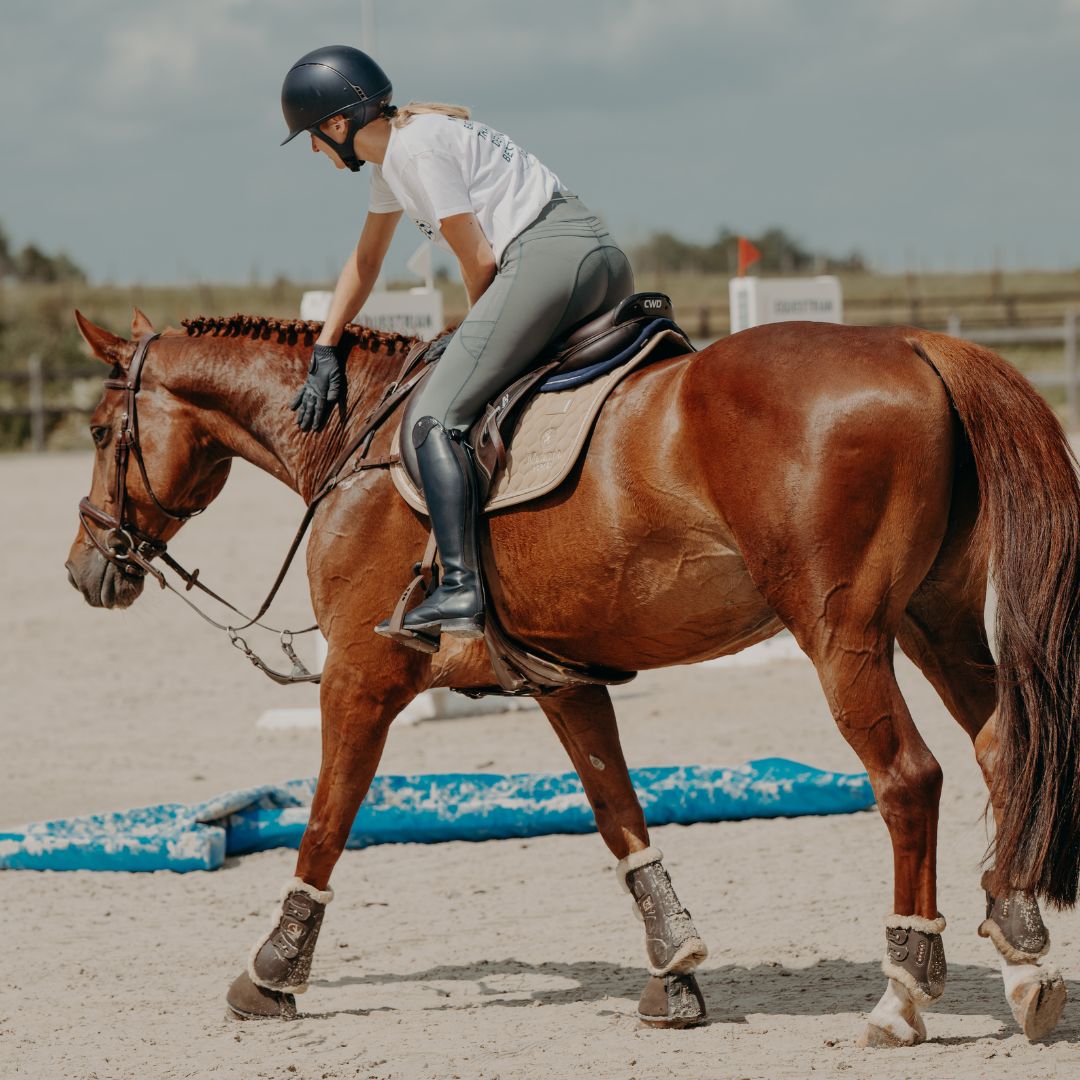
Your horse’s weight: the foundation of health, performance and insight
In practice, a horse’s exact weight is often still an estimate. Many owners rely on appearance: if a horse “looks good,” it must be fine.
But appearances can be misleading.
A horse’s weight is not a minor detail, but a fundamental parameter that directly affects health, performance, and overall well-being. Without objective measurement, every feeding and training plan remains based on assumptions.
And that’s exactly where the problem begins.
Why your horse’s weight matters
A horse’s body weight affects multiple systems at once. On the one hand, there is mechanical load: every extra (or missing) kilogram has a direct impact on joints, tendons, and ligaments. On the other hand, weight also plays a role in metabolism and hormonal balance.
A horse with a suboptimal body condition either carries more weight than its body is designed for, or lacks the necessary reserves to function properly.
A healthy weight is therefore not an aesthetic preference, but an essential foundation for long-term performance and durability.
From estimation to objective measurement
In reality, a horse’s weight is rarely measured accurately. Many owners rely on estimation or intuition, even though small differences can have a significant impact.
A deviation of just 20 kg in a 500 kg horse can already lead to noticeable changes in load and energy requirements.
That is why objective monitoring is essential.
Determining the horse’s weight, combined with an accurate Body Condition Score (BCS), forms the starting point of any well-considered management plan. Only when these parameters are known can nutrition be properly adjusted and training structured effectively.
More than just weight: insight into condition and health
Weight alone does not tell the full story. The distribution of body fat and the horse’s physical fitness are equally important.
A horse may have an ideal weight but still show an unbalanced body condition. Conversely, a horse with a slightly higher weight may still be functional and healthy, depending on its discipline and workload.
That is why it is important to look beyond numbers and assess the complete picture:
- body condition
- nutrition
- training level
- recovery capacity
When these elements are evaluated together, they provide a clear and practical insight.
The role of nutrition in weight management
Nutrition plays a central role in achieving and maintaining a healthy weight. Not only the quantity, but especially the composition of the ration is key.
Feeds high in sugar and starch can disrupt metabolic balance and promote fat storage. In addition, certain ingredients may add volume without providing real nutritional value, leading to an unnoticed excess in energy intake.
A well-balanced ration always starts from the essentials:
- tailored to the horse’s actual weight
- adapted to its workload
- based on fibre-rich, high-quality ingredients
Roughage remains the foundation. An adult horse requires on average around 2% of its body weight in roughage (dry matter) per day to support digestive health.
Optimising weight is therefore not about feeding less, but about feeding smarter.
From data to targeted action
Where horse management used to rely mainly on experience and intuition, technology now makes it possible to work in an objective and measurable way.
With tools like Hipposcan, you can easily determine your horse’s weight using a photo and a few key details. This information is combined with an analysis of body condition, nutrition, and fitness.
The result is not a rough estimate, but a clear and actionable insight:
- an accurate weight indication
- an evaluation of body condition
- tailored nutritional advice
- insight into fitness and recovery
- a practical 4-week training plan
By combining all this data, you can make informed decisions that are fully tailored to your individual horse.
Measuring is knowing
Preventive horse management starts with objective data.
By regularly monitoring your horse’s weight and condition, you can make timely adjustments and prevent problems instead of reacting to them afterwards.
It not only provides more control, but also greater confidence in your decisions regarding nutrition and training.
Conclusion
Your horse’s weight is not a secondary detail, but the foundation of health and performance.
Without insight, management remains based on assumptions. With the right measurements and tools, it becomes possible to tailor nutrition and training precisely and support your horse in the best possible way.
A healthy horse starts with insight. And insight starts with measurement!
This blog was created in collaboration with Hipposcan.
Want to learn more? Contact us!